This is the early version of my animatic with no sound added yet.
Showing posts with label Story & Commission. Show all posts
Showing posts with label Story & Commission. Show all posts
Sunday, 5 March 2017
From Script to Screen Animatic (No Sound)
This is the early version of my animatic with no sound added yet.


Wednesday, 8 February 2017
From Script to Screen: OGR 2 (First Draft)
This is my first iteration of this OGR. I'll be posting a more complete version including character designs for my second character, prop designs and influence map and my completed storyboard, as soon as possible.
Tuesday, 7 February 2017
Storytelling & Commission: Script Version 2
Jingle Blues V2 by Zoe Thornton on Scribd
This slightly revised version of my script aims to fine tune and sharpen the pace and wit I want to convey in the final piece. I decided to give the character of Santa a slightly more foreboding presence, to bring about tension if the Elf doesn't get the doors open and the whole facility working in time.
Wednesday, 1 February 2017


Tuesday, 31 January 2017
@Phil: Further ideas for plot
Looking through your feedback for my story and how it could go, I've had sort of branching ideas. The main point of what I wanted for the story is not to paint any character as antagonistic and for the audience to pick up on sympathies for the main character, being the Elf, stuck in job he dislikes and nobody really listening to him. However, I do also see great opportunities a character vs. character set-up, since the main theme of this story could be called frustration. I think I get a clear picture in my head of Santa arriving and the Elf wants to follow procedure to let him in with his key card, but Santa just goes about ignoring the order of how things are done, and though Santa is his boss, it gets under the Elf's skin, and he has to follow around Santa fixing all the mess he makes. Your suggestion of the Pixar short 'Presto' can clearly influence this sort of battle of wills type story outline. It's slightly more chaotic and based on slapstick then my original idea.
In keeping with my original story idea, which is based around the frustration of tedious sort of actions, I think I could simplify it, and base story gags around expressions. I wanted it to be a commentary on never being able to get anything fixed for you in an office, so it could be the Elf trying to get the doors to the Space Station to open before Santa arrives but he key card has been disabled. It can be set up simply so he's talking on the station tannoy to get it fixed but he's being directed back and forth to different departments and has to rush to fill out order forms to get his password for the system changed and get a new key card. I think a gag I could set up instead is that they keep playing 'Jingle Bells' as the hold music and the Elf then figures out instead of waiting the be granted access, he can just hold up the speaker and the doors open as Santa walks in, efficiently doing his business, allowing it to end on a happy note.
In terms of set up, it reminds me of this scene from Zootropolis and speaks to me in it's accurate depiction of desperation to get things done on time and waiting for people to do their job.
Let me know what you think of both of these ideas. I'm getting good ideas for storyboarding set-ups for both of them and would like to see what you think.
In keeping with my original story idea, which is based around the frustration of tedious sort of actions, I think I could simplify it, and base story gags around expressions. I wanted it to be a commentary on never being able to get anything fixed for you in an office, so it could be the Elf trying to get the doors to the Space Station to open before Santa arrives but he key card has been disabled. It can be set up simply so he's talking on the station tannoy to get it fixed but he's being directed back and forth to different departments and has to rush to fill out order forms to get his password for the system changed and get a new key card. I think a gag I could set up instead is that they keep playing 'Jingle Bells' as the hold music and the Elf then figures out instead of waiting the be granted access, he can just hold up the speaker and the doors open as Santa walks in, efficiently doing his business, allowing it to end on a happy note.
In terms of set up, it reminds me of this scene from Zootropolis and speaks to me in it's accurate depiction of desperation to get things done on time and waiting for people to do their job.
Let me know what you think of both of these ideas. I'm getting good ideas for storyboarding set-ups for both of them and would like to see what you think.
Monday, 30 January 2017
Storyboarding Exercise: From script to storyboard (The Hogfather, 2005)


Monday, 23 January 2017
Friday, 13 January 2017
@Phil: Initial story idea


- A key can really be anything, as long as it unlocks something, and given context for where the key is and the theme of the story. So in design it could have sci-fi elements, or a Christmas theme element to it.
- I thought of Christmas toys that have mechanisms to them, and settled on a snow globe, so maybe one with a special feature.
- I turned it around, so now the Snow globe is the thing being unlocked, because it is a room in the Space Station. The station could be a present outpost and lookout for Santa while he's on delivery, if he forgets to pack certain presents or if he forgets to visit a country.
- The plot could be centered around an Elf who is in charge of the remote station in space. He could be unpopular with the other Elves because he's more of a career Elf and more focused on efficiency then embracing the Christmas cheer.
- So the story idea is Santa coming to visit the Space Station while on his rounds and gets stuck in the visiting drop-off area themed around a snow globe. The main conflict of the story could be around the Elf trying to unlock the door to the snow globe, which I see is designed deliberately and annoyingly to unlock to someone in the Christmas spirit. I sort of see him having access to a key card or something that would normally unlock the door, but it's been deliberately disabled by someone who is trying to force him to be cheerful, as there is another way to open the door, by singing 'Jingle Bells' or another irritatingly cheerful song, which would be the true 'Key'. I see the resolution of the story being the Elf having to swallow his pride to save Santa, and in doing so is rewarded by being taken seriously in his objections to everything designed by Elves to have a Christmas theme because it can cause bizarre safety risks.
Like For Like Storyboard part 1: The Lego Movie (2014)

I am currently working on drawing up the Like-For-Like storyboard in preparation for my own storyboard for the storytelling and commission project. I chose this scene from the Lego Movie, directed by Phil Lord and Christopher Miller (2014), as the action is directed in various camera moves and the coverage of each camera is different. I haven't quite finished storyboarding the frames, so I thought I'd post this to keep my blog regular with my work. When I finish, I'll put all the pages together with descriptions of the camera movements.
Character Design Workshop: Simplifying Design
In our first lesson the character workshop, we went over what makes a character. Due to how they are characterized in the story, that gives the designer visual clues to then start out to figure out what they look like. The style of the character drawn is influenced by the genre and by who the piece is intended for, with simple shapes generally more for a younger audience. In animation, you tend not to see truly realistic human characters unless in video games, because the more realistic a cartoon is drawn, you start the realize the proportions don't always fit with real life proportions, and the more you try to make a character fit realistic proportions, the more you lose the design and style of the original character. When thinking of a character, it's best to break them down into shapes, which are commonly circles, rectangles and triangles. These shapes give strong indicators to a character's personality and role within the story, so are only made up of one or two of these types of shapes. After discussing how these shapes were important for beginning to design a character, we were all each given an example of an existing character to breakdown, simplifying them in shape, but still keeping their features recognizable.
My character was The Hulk, a comic book hero. On my first attempt, I tried to simplify him down, as he was drawn in the example to be perfect mix of a realistic, advanced style of design, yet you could tell he was a cartoon character. The basic shape of the Hulk was purely rectangular but there was definition in the muscles and the way the features were drawn that wasn't perfectly copying Human anatomy but was complex enough to tell anyone looking who the character was and what demographic the drawing was following. I had trouble with the features of the face, as the way I drew it made who I was drawing resemble the Hulk less.


 |
| The Hulk example |


This time I started of trying to draw realistically, but again losing The Hulk.

I finally started to break him down to his core shape, simplifying him to see ho he is really made.

From there, I added some of the definition back, but deliberately kept some features back, like his cheekbone. It's still enough to make his recognizable as the Hulk, but simplified for a purpose.
Tuesday, 10 January 2017
From Script to Screen: Storytelling and Commission Project Ideas
For the project brief, I must create a story and all pre-production based around these three words I pulled out of a different bag at random.



A Space Station is my environment, which opens up new possibilities for characters and design. Perhaps the station is in command of Santa, to monitor Earth and it's population and to ship out presents more efficiently. It could be that Santa needs to deliver presents to the Space Station. Would the stationed be Christmas themed. Or are elves actually aliens?
And finally the prop, being a key. Because now I have my two other crucial parts to the story, a theme presents itself to me. A key can be anything that unlocks something, and what's more, it could be sci-fi/ Christmas themed.
Now I have my three elements, and I've got loads of possibilities and ideas to start planning plot elements on. My first step should be to come up with a list of everything that comes to me in terms of what the character, environment and prop could be like and how they relate to become story ideas.
Friday, 29 April 2016
Sunday, 24 April 2016
Fantastic Voyage: scene models


Experiments in early stage Zika virus cell textures


First scene model
Fantastic Voyage: Development for Cell Cityscape
 |
| Concept drawing for the different building in the cell-city. They are purposefully DNA-like in design. |
 |
| Working out the orthographs of the buildings. |
Monday, 18 April 2016
Fantastic Voyage scene progress
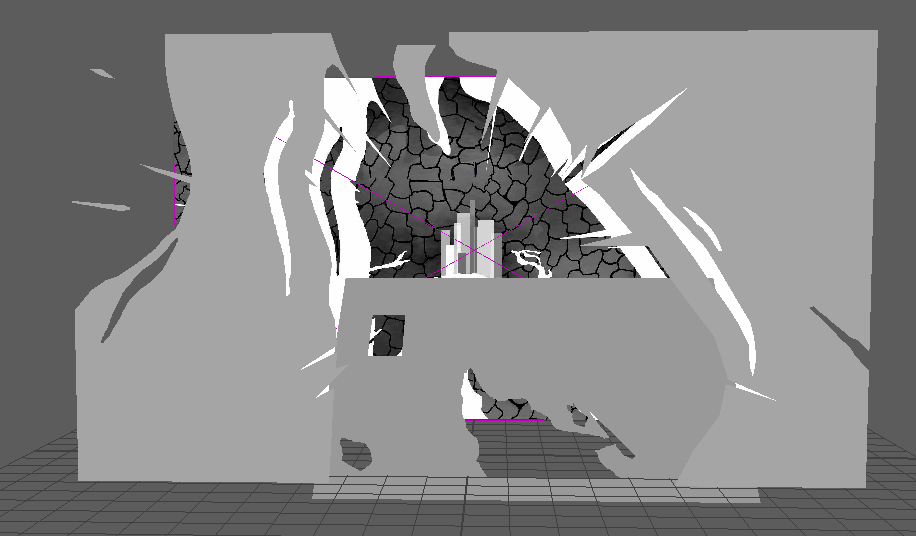
After my first attempt at the scene (see below), I decided to simplify the modelling to cut down on time, but I'll still be adding 3D elements to the scene in the background and foreground.

Thursday, 17 March 2016
Fantastic Voyage: The Pin board and the map

This concept art for the detective's pin board is what I'll be using as a framing device in my animation project. Each branch represents a different area of topic about the zika virus, which are: how the virus spreads through Human cells, symptoms of the virus (including the topic of birth defects), the spread of the virus worldwide and how the body fights the virus.
This is a quick, early stage animation I made for the pitch, as part of a showcase of which countries are now affected. A narrator will explain where the virus had been tracked to and where the different strands and mutations of it are located, wondering where it will next be located.


Fantastic Voyage: Character Design

This is character design work for the Zika virus. I was primarily testing out a prohibition-era Gangster design for the cell. Its RNA strand produces more Zika Gangsters which combine to take down the city. Following some advice from Jordan, I also tried a more ambiguous design route, to convey the idea that the Zika Virus is still being researched and parts are still unknown.
Subscribe to:
Posts (Atom)